
2026 Lake Vermilion Loon Camera Live Stream
______________________________________________________________________________________________________________________________
The Live LoonCam’s Last Sunrise of the Summer
By Noel Sederstrom, VLA Volunteer
Lake Vermilion, Minn. (VLA) – The Kingfisher listened to the loons calling to each other miles away out on the lake. The seagulls, too, cried out to each other about the sun just coming up. It was 5:43 a.m. on Saturday, August 8 when the Kingfisher flew up to perch on a branch of a bush, the beginning of another fantastic day on Lake Vermilion.
The beautiful bird was just taking time to watch and listen, to see what was happening. Just like all of us watching the Vermilion Lake Association’s Live LoonCam. What a privilege to just watch and listen to Lake Vermilion.
A few minutes later, the Kingfisher dove for the water for his breakfast and we can hear thrashing and splashing noises, and are left to imagine what is happening in the shallow water behind the loon family’s little island. On many mornings, the loon family could be seen swimming and diving in the bay behind that little island. The two loon chicks are now almost as big as the parents and are growing feathers. Soon it will be time for Flight School.
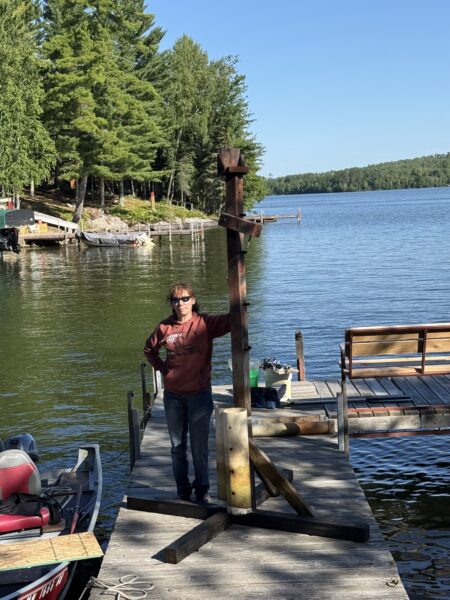
The VLA’s Nancy Swanson stands with the cam post after it’s lifted to a dock on Saturday, August 8
This was the last morning for our Live LoonCam for the summer. The team had decided this was a good day to pack it all up for the year, to put it into storage until next May.
A little past 8 a.m. they pulled the plug and unhooked the Ethernet cables, gathering all the electronic parts and carefully packing things away for next year.
Our Axis P1465-LE camera is bolted to a post with a base crafted a number of years ago by Bill Michaelson. We have a parabolic dish mic bolted in place too. When the team carefully places the contraption in the water in May, it’s weighted down so that it sinks into the mud bottom on its own. It all works great, but it’s quite a chore to lift it up and haul it out of there.
A huge thank-you to these wonderful people for making this happen. Here you see Nancy Swanson posing by the cam post after it’s brought up to a dock.
Rick Teeter is taking on a bigger role now with our Marine Team and we’re grateful he took a few photos of the process!
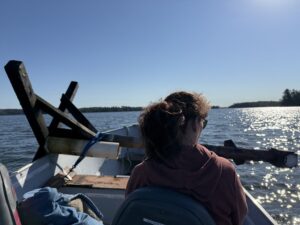
Heading for winter storage with all the gear (photos by Rick Teeter)
Bill was along on Saturday morning as well, along with Tom Tamte and Eric Hanson.
Tom was a huge help to ALL OF US this summer as he was the one who answered my calls and ventured over multiple times to clear spiders and cobwebs from the cam. The view gets ruined pretty quickly when a spider decides to park in front of the lens!
We sure love our Infrared technology so we can “see” after dark but one thing it does is attract bugs of all kinds. 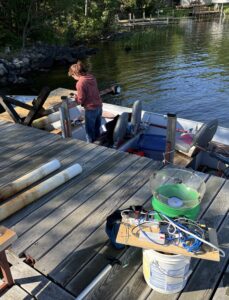
And we’re indebted to Eric in so many ways, the most noticeable being his videos and photos of the loon family taken from water level.
Eric has been carefully monitoring them for the past two months, sometimes tracking them down as they wandered around the area, later sharing his photo and video treasures.
All of us with the Vermilion Lake Association want to pass on our sincere thanks to Access Broadband of Virginia, Minnesota, for the WiFi tower internet uploading power that made this project possible this year. The livestream to our VLA YouTube Channel had 59,923 views up to the morning it was powered down, from an estimated 28,548 unique viewers from all over the globe! And many of them contributed too. YouTube analytics counted 7,302 chat messages as people kept track of our loon family and compared notes. Many a friendship grew from the time spent in our YouTube “chat room.” But the livestream itself became a big part of life for many people who didn’t leave chat comments.
“I love the cam!!!” said Brenda Franklin on our Facebook page. “Even after the loons left, I had it on all day at work just to listen to the water, the birds, an occasional loon, boats and kids playing at the end of docks, it made me feel like I was still up at the cabin.”
Thank you Brenda. That’s exactly how many of us feel too! Hope to see you and everyone next year.
______________________________________________________________________________________________________________________________
A Loon Family Update:
Loon Chicks Almost Ready for Flight School – 3:28 p.m., August 6, 2026
By Noel Sederstrom, VLA Volunteer
Lake Vermilion, Minn. (VLA) – We’ve had a lot of fun watching the two loon chicks “grow up.” They hatched back on June 11, so this video shows them at exactly eight weeks old, and as you can see they are losing their baby fluff and growing real feathers. It will be time for Flight School before long. Hard to tell when the first day of school will be this year on Lake Vermilion.
Thanks to Eric Hanson for sharing the video!
______________________________________________________________________________________________________________________________
A Loon Family Update:
Breakfast time for the Loon Family – 9:31 a.m., August 6, 2026
By Noel Sederstrom, VLA Volunteer
Lake Vermilion, Minn. (VLA) – The loon family we’ve been following this summer at Lake Vermilion seems to enjoy being near their human neighbors, and the laughter of children playing. Just feet away from where some boats are docked along the shoreline, they’re busy hunting for their breakfast. They know they’re safe right where they are swimming and diving.
Thanks to Eric Hanson for sharing the video!
______________________________________________________________________________________________________________________________
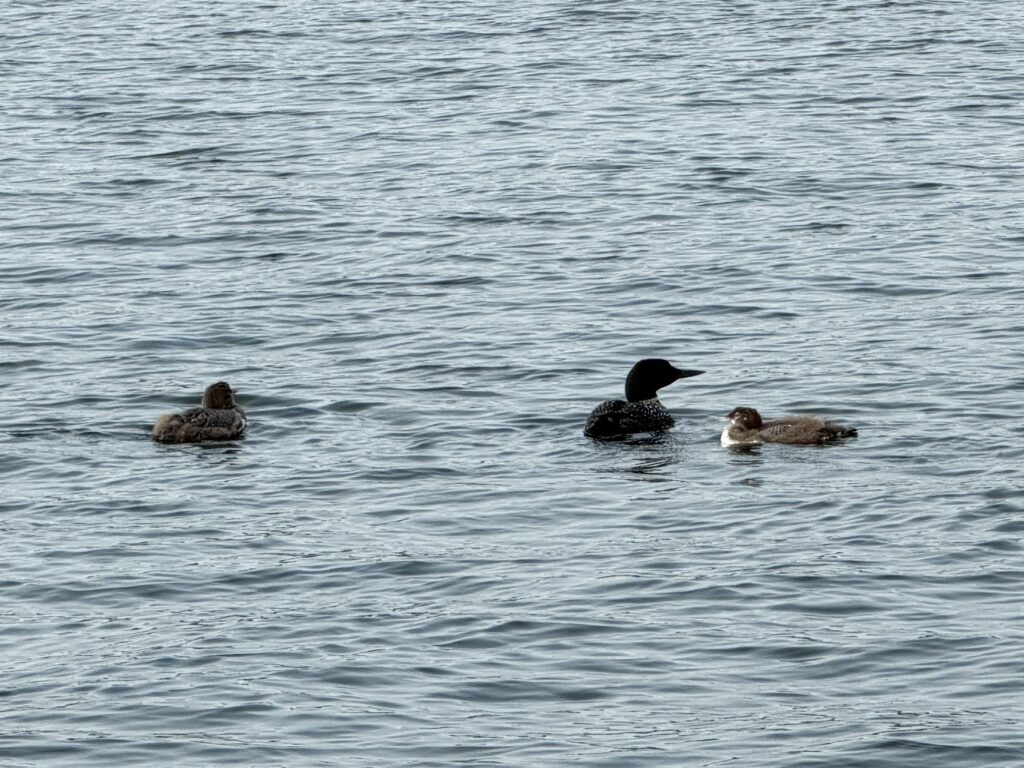
The loon chicks are losing their “fluff” (Photo by Eric Hanson)
A Loon Family Update:
Chicks Evolving, Now Growing Feathers – July 29, 2026
By Noel Sederstrom, VLA Volunteer
Lake Vermilion, Minn. (VLA) – The two littles are losing their baby fluff!
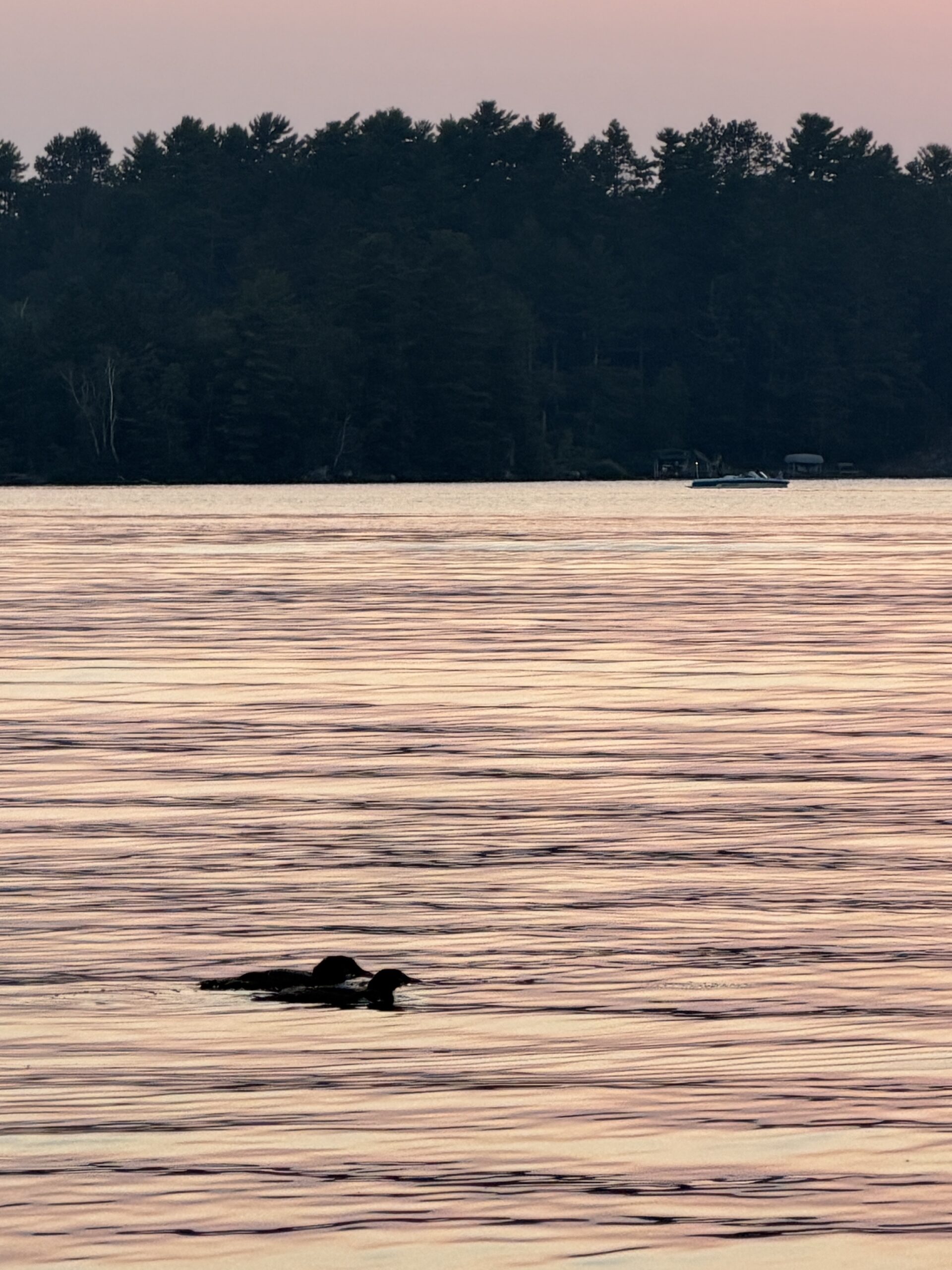
Check out these shots from water level.
Live LoonCam team member Eric Hanson tracked them down; the first image is from Monday evening, July 27, and the “sunset glow” shots are from July 28. Thanks Eric!!
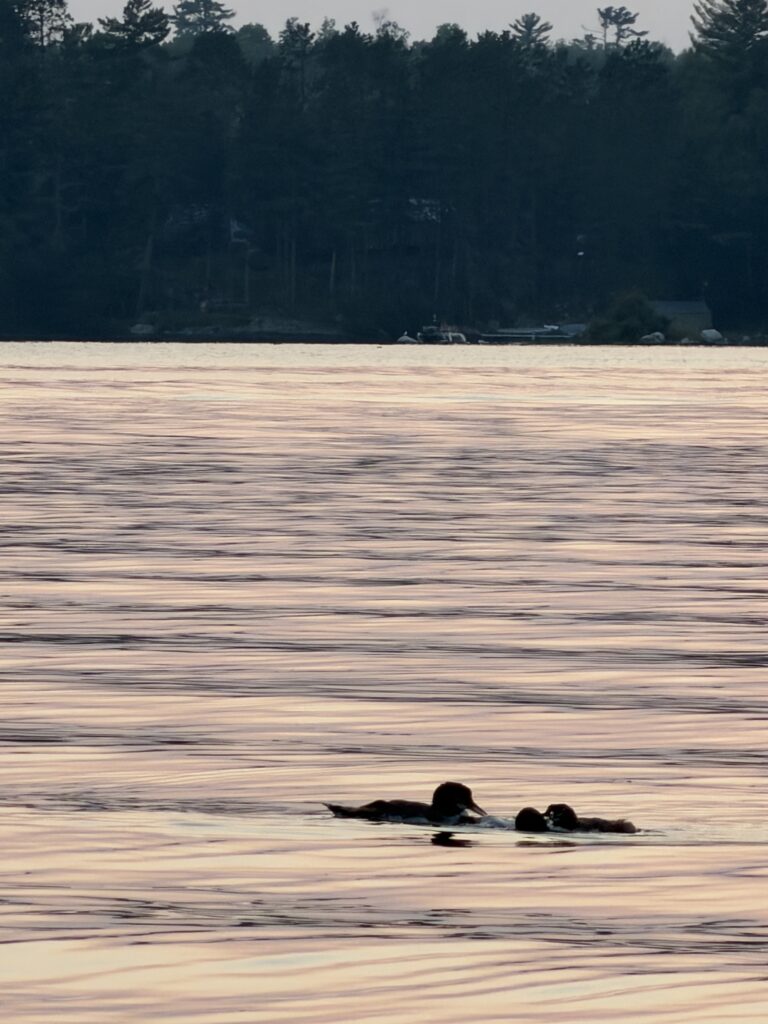
Almost always, one of the loon parents is nearby, coaching the chicks
“Loons still doing well and staying in our area,” he noted.
Experts say they start to grow real feathers at four weeks.
By ten weeks (late August for these two) they will be considered fledglings.
If you’re out in your boat, please give the loons plenty of distance. A rule of thumb on it from the experts is a buffer of about 150 feet.
—————————————————————————————————————————-
______________________________________________________________________________________________________________________________
From the Loon Family Highlight Reel:
Loon Chicks Dive and Hunt for Food
By Noel Sederstrom, VLA Volunteer
Lake Vermilion, Minn. (VLA) – Weeks have gone by, every day a new experience for the loon family we’ve been watching. Here’s an update on the two loon chicks from the early morning hours of July 26. A parent is never far away.
You can hear a boater gunning it while roaring away on Lake Vermilion.
The chicks are just over six weeks old… and they are getting so big!
The VLA’s Live LoonCam is still powered up at this point, and that’s where these images are from. Every once in a while, the chicks and one or both of their parents pop up as they are diving and hunting for food. They roam a wider area now than just the bay behind their little island.
On this particular morning another familiar guest also makes an appearance—it’s a fan favorite of our YouTube chat room folks. It silently swoops in to sit on that big rock just beyond the loon family’s nest spot on Lake Vermilion. Wait for it–!
It’s the loons’ familiar neighbor, Great Blue Heron. It is hungry too, searching for breakfast.
______________________________________________________________________________________________________________________________
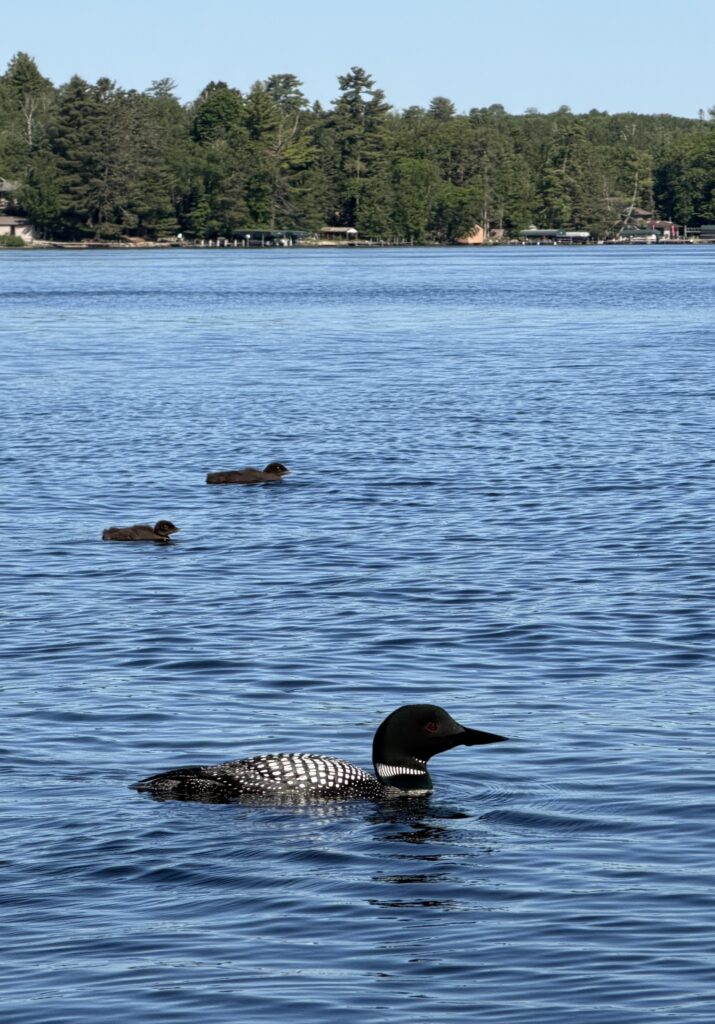
Two loon chicks and one parent, out swimming on Lake Vermilion on June 30 (Photo by Eric Hanson)
Getting stronger every day… now up to us to give loon chicks space – July 4, 2026
By Noel Sederstrom, VLA Volunteer
Lake Vermilion, Minn. (VLA) – With America’s birthday coming this year on a Saturday, there might be a record number of power boats out on Minnesota lakes for the 4th of July holiday weekend.
But some of the least experienced swimmers will also be out in the middle of Lake Vermilion in the middle of all those boats.
The little loon chicks we’ve been following since they hatched June 11 are getting stronger every day, and they’re growing! But they are still only three weeks old. It will be up to us to give them a lot of space out on the water.
Thanks to Eric Hanson, a member of our Live LoonCam Team, for tracking the little loon family down in his boat, and getting just close enough for these images of the little ones. We’ve zoomed in to his photos to create these closeups.
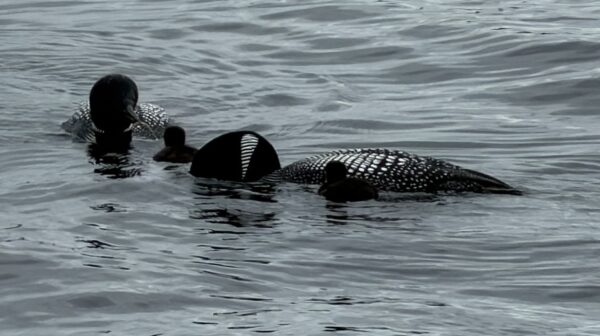
The loon family swimming out on Lake Vermilion on June 17 (Photo by Eric Hanson)
______________________________________________________________________________________________________________________________
From the Loon Family Highlight Reel:
Youngest Chick Climbs Up on Mom’s Back
By Noel Sederstrom, VLA Volunteer
Check out this heartwarming moment from our Live LoonCam, this is from 4:31 p.m. on Friday, June 12.
With the wind gusting and the sun shining brightly, the youngest chick finally felt strong enough to climb up on Mom Loon’s back. It was a “coming out” moment for Little Fluffy—gaining strength by the minute.
An hour later the chick would be in the water.
So tiny! The loon family all went out on the water of Lake Vermilion a short time later.
The chicks and Mom Loon came back to spend one more night in their nest on the little island and after that… they were out on the water for good.
______________________________________________________________________________________________________________________________
From the Loon Family Highlight Reel:
Little Loon Chick Explores the Shoreline
By Noel Sederstrom, VLA Volunteer
Lake Vermilion, Minn. (VLA) – The day after the loon chicks hatched, each one gained strength quickly.
There was a gap of about eight hours between the time the oldest one started swimming with the parents, and when the younger one was strong enough to begin moving around.
So what’s a loon chick to do with all that spare time?
One thing came instinctively—the older chick began exploring the shoreline of the loons’ little island where the parents had built their nest.
Thanks to Eric Hanson of our Live LoonCam team for sharing this video clip of the little one! One day old, already busy figuring out which way is up.
______________________________________________________________________________________________________________________________
From the Loon Family Highlight Reel:
The Moment the Oldest Chick Jumped into the Lake
By Noel Sederstrom, VLA Volunteer
Lake Vermilion, Minn. (VLA) – Friday, June 12, was a wonderful day for “our” loon family–both chicks had hatched the day before with no problems.
This was the day they were expected to hit the water. It does happen quickly! Time for swimming lessons.
The tricky part for the parents is to persuade the littles to take that first leap into Lake Vermilion.
When Mom Loon’s gentle coaching didn’t seem to work with the older chick, Dad Loon came up with a novel approach a couple hours later.
He returned at 9:32 a.m. with a snack in his beak and climbed the hill to the nest.
Watch what happened next. If you wait for it, you’ll hear the “birth announcement” from both proud parents to the entire Lake Vermilion community.
______________________________________________________________________________________________________________________________
Red sky at night, was Mom Loon’s delight
…both loon chicks hatched and made it to the water – June 16, 2026
By Noel Sederstrom, VLA Volunteer
Lake Vermilion, Minn. (VLA) – The loon family we’ve been following since mid-May has made its way out to the deeper waters of Lake Vermilion.
Now there are four family members!
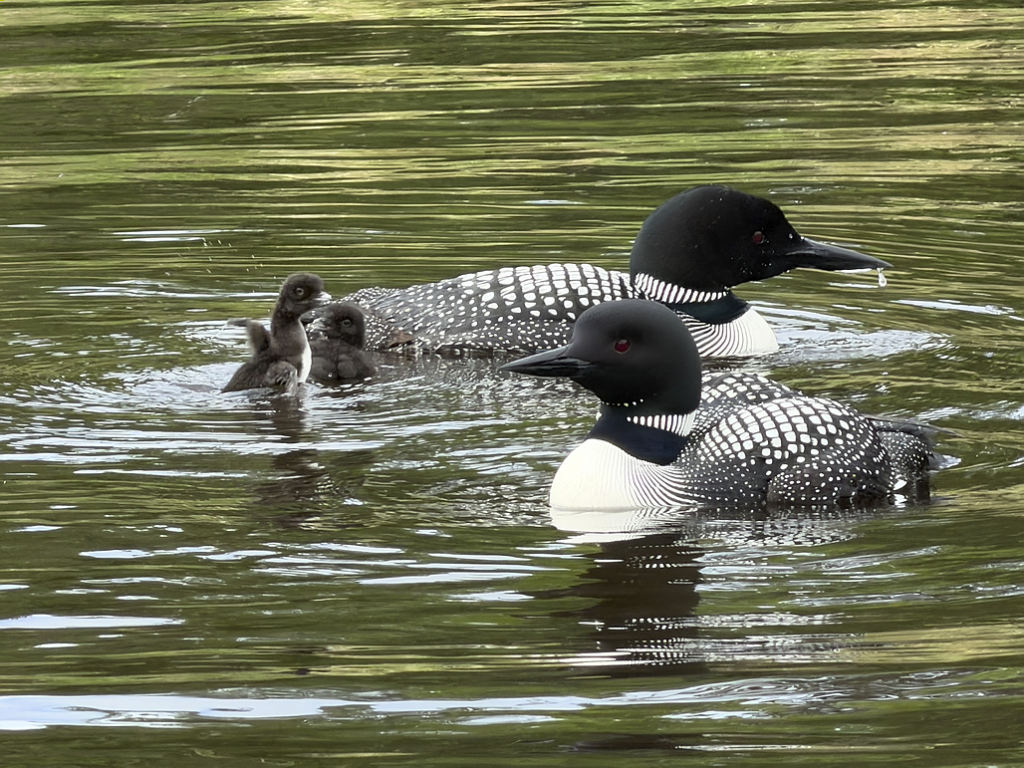
One-day-old loon chicks clamor for attention (Photo by Eric Hanson)
Two beautiful fuzzy loon chicks hatched about 12 hours apart on Thursday, June 11, just as predicted by our expert loon watcher GailMNLakeGal a few weeks ago.
This is their beginning-of-life story.
Live LoonCam team member Eric Hanson took a few spectacular photos and video clips of the chicks and their parents in the first 24 hours as the little ones were just practicing swimming and climbing skills.
From everything we can tell, they’re healthy, hungry and full of crazy energy.
After being cooped up, a very liberating experience!
We first noticed Mom Loon sitting on a natural nest she had chosen back on May 15.
Two days later, our Live LoonCam team of Bill Michaelson, Tom Tamte, Nancy Swanson and Rick Teeter carefully installed our camera post in the shallow water about 15 feet from the nest, as Mom Loon watched.
Since then, it has been a lot of diligent work for the mating loon pair caring for two eggs.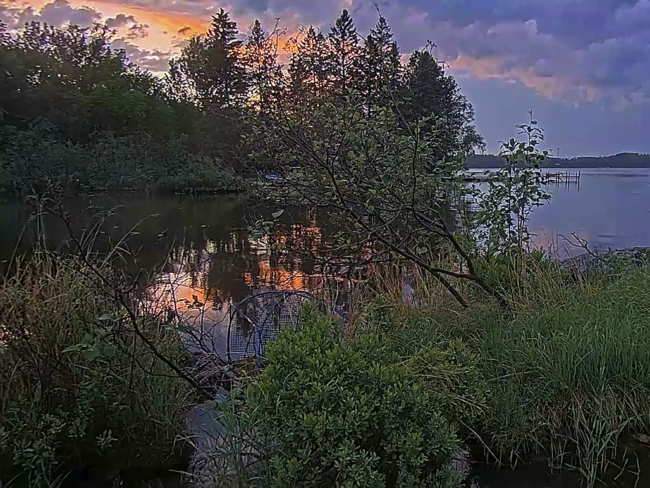
Approaching “Hatch Day” a rainy front moved through, then it cleared, leaving a breathtaking red sky sunset.
Red sky at night became “our” loon mom’s delight.
One of our loon-watchers, judygilbert9628, offered that she heard peeping noises about 1 a.m. on June 11 as the chick was still inside the shell.
Over the next ten hours, the chirps became louder and clearer.
For Mom Loon, it took tremendous patience to quietly guard her nest, with birds singing and splashing all around her, and even a bumblebee flying by to check things out. The older chick was a chatterbox!
At last, a shift change came with her partner taking a turn, and Mom Loon hit the water to recover some of her energy.
It wasn’t until 6:18 p.m. Thursday that the oldest chick made an appearance, climbing up on Dad Loon to greet the world.
It was GailMNLakeGal who spotted it first. “I see the chick. 18:16:30. He’s sitting on top of Dad’s rear end as if they were in the water.”
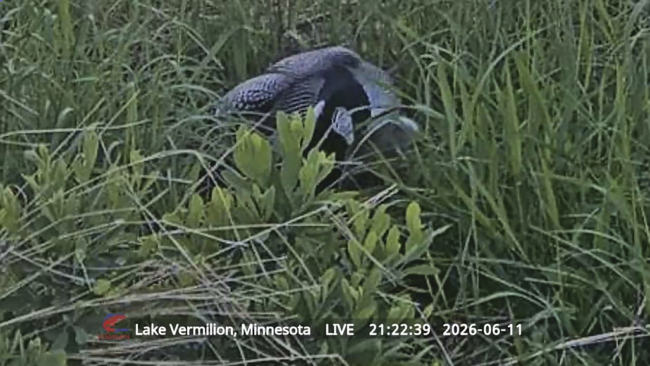
Mom Loon had two chicks to protect as night fell on June 11
The youngest chick hatched shortly after that and three hours later Mom Loon was protecting two little ones for the night.
The next day would be super-important, for the chicks would be expected to begin a life in the water.
With dawn breaking on Friday, June 12, it was Mom Loon taking the lead. Twice she dove down the pathway to the water trying to get the oldest chick to follow.
Hours later, it was Dad Loon with a little Dad trick that made the difference. It was 9:32 a.m., four and a half hours into the whole thing, when he arrived with a snack from the lake in his mouth.
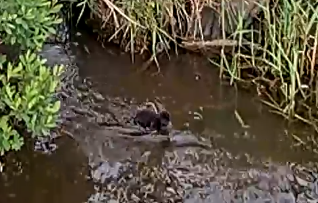
The first chick to hatch comes charging out onto the water
He charged up to the nest, and delivered it to the little one, then dove back down to the lake with Mom Loon.
At that… the oldest chick came charging down the path as if shot out of a cannon.
And the parents screamed a “birth announcement” at the top of their lungs to everyone within five miles.
“The parents are very excited,” noted loon-watcher medusassnakes70 in our YouTube chat room.
From debrab8109—”Love the birth announcements!”
Added claremc2130… “Hi everyone, thank you for amazing tstamps, the chick is so sweet and the announcement always gives me goosebumps”
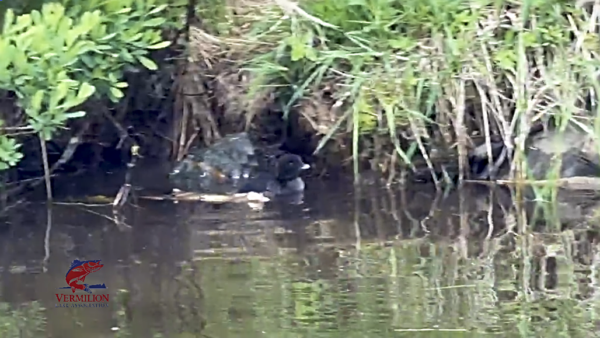
Older chick exploring the shoreline below the nest with encouragement from above (Photo from Eric Hanson)
During the daytime hours, the oldest chick explored the shoreline and learned how to come up and down to the nest.
As he peeped and chirped away, Mom Loon cooed encouragement to it from the nest above.
It took almost all day for the youngest chick to build up the strength to join in.
At about 4:30 p.m., it emerged and came into our view for the first time, climbing up on Mom Loon’s back.
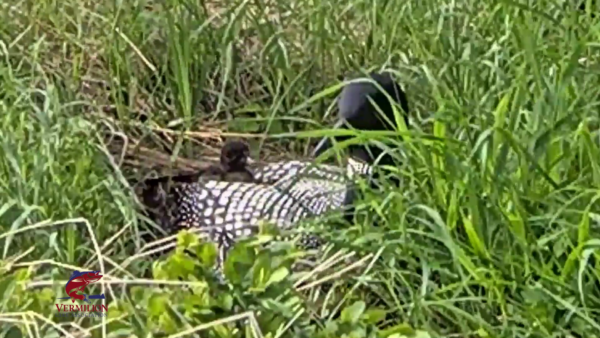
At 4:32 p.m. June 12, the second chick is strong enough to climb onto Mom Loon’s back
“Little Fluffy” we started calling it as dozens of us chatted back and forth on our YouTube Channel site watching it all unfold live in real time.
An hour later, both chicks were in the water, swimming and skirmishing mightily.
“Wish each parent would just take one on their backs and keep them separated xD,” said Silvery1313 with a laugh.
And then… they were gone.
Out onto Lake Vermilion.
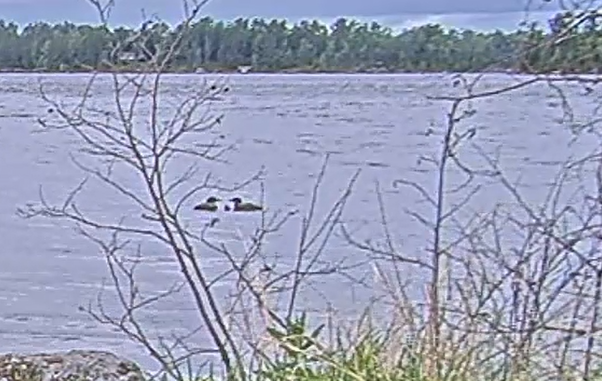
The loon family spent most of Saturday afternoon out in the waters behind their little island
We got a quite unexpected surprise a little later—Mom Loon and the two chicks came back that night to sleep in the nest one last time while Dad Loon was out patrolling nearby.
At 8:48 p.m. the two chicks were still engaged in the Battle of the Century, both climbing atop Mom Loon where one attempted to chew on her wing.
“Mama seems to be waiting pretty patiently,” noted tailfeather6317. “I guess she’s just waiting for the ‘all clear’ from the lake side.”
And so it went; the parents proving to be a championship team through it all. It didn’t go perfectly; Mom Loon and one of the chicks were flushed by a threat the next morning.
But later, there they were, all four of them, out on the lake. Swimming, diving, hitching rides, playing, climbing, eating.
The chicks are getting stronger.
______________________________________________________________________________________________________________________________
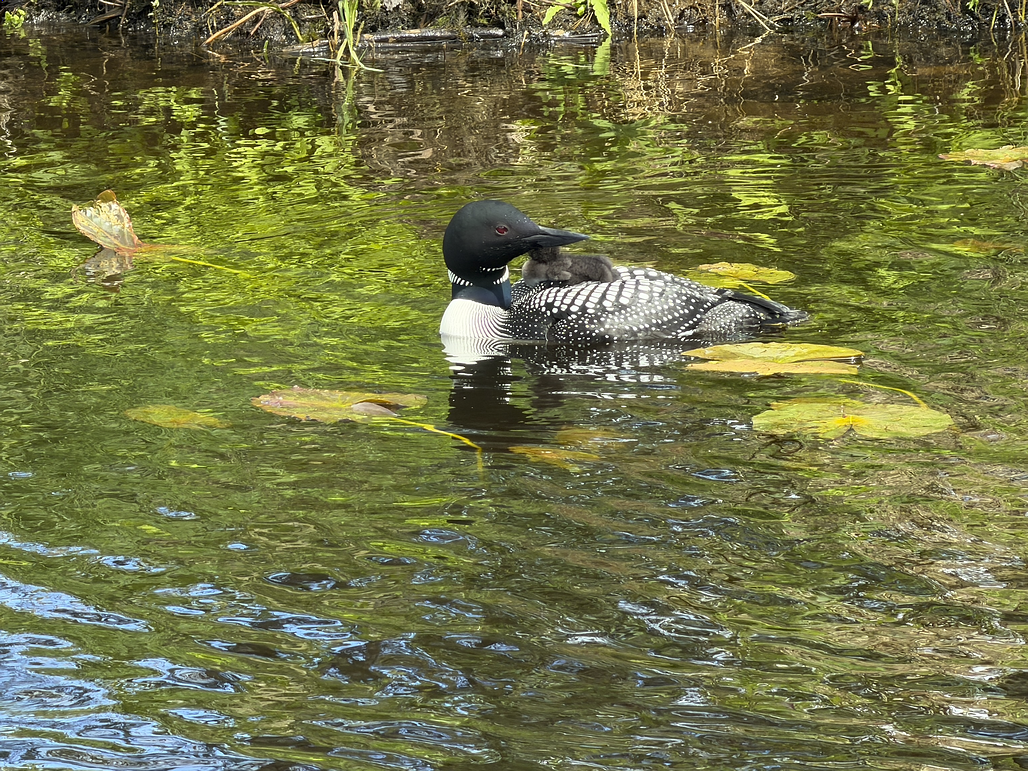
Chick gets a joyride around the lake from Dad Loon (Photo by Eric Hanson)
______________________________________________________________________________________________________________________________
The mating pair successfully brought the two new loon chicks into the Lake Vermilion ecosystem with a combination of caring, patience, persistence and problem-solving skills. All of us are rewarded!
It took a couple of weeks, but the highlights of our loon chicks’ Hatch Day and the day that followed have been fashioned into a highlight reel kind of tale. For this video, “Red Sky at Night… Mom Loon’s Delight,” a special thanks to Eric Hanson, who contributed images and video clips from the water at “loon-level.” A link to the video is directly below.
The Vermilion Lake Association thanks Access Broadband of Virginia, Minnesota, for the excellent WiFi internet service for our project.
We gratefully thank and acknowledge the following music producers for licensing the use of their works via the Free Music Archive, portions of which are used in this video production:
*Corporate Waves by Yuri Megis, used with CC BY
*Aurcalm-Tree Whispers by BLV8ION, used with CC BY-NC-ND 4.0 International License
*Educational by Soundore, used with CC BY-ND 4.0 International License
*Right Happenings by Pamela Yuen, used with CC BY 4.0 International License
*Upbeat Dream (Inspiring Motivation) by Puma Tunes, used with CC BY-NC-ND 4.0 International License
*Funky Rhythm Express by Pumpupthemind, used with CC BY-NC-ND 4.0 International License
*Cinematic Inspirational Background Music by AurosonMusic, used with CC BY 4.0 International License
*Beyond the Stars by Maarten Schellekens, used with CC BY-NC 4.0 International License
The Free Music Archive can be explored at https://freemusicarchive.org
If you’re out on your boat this summer, please give the loons plenty of distance!
______________________________________________________________________________________________________________________________
Caring for two eggs, loons are “Takin’ Care of Business” – June 7, 2026
By Noel Sederstrom, VLA Volunteer
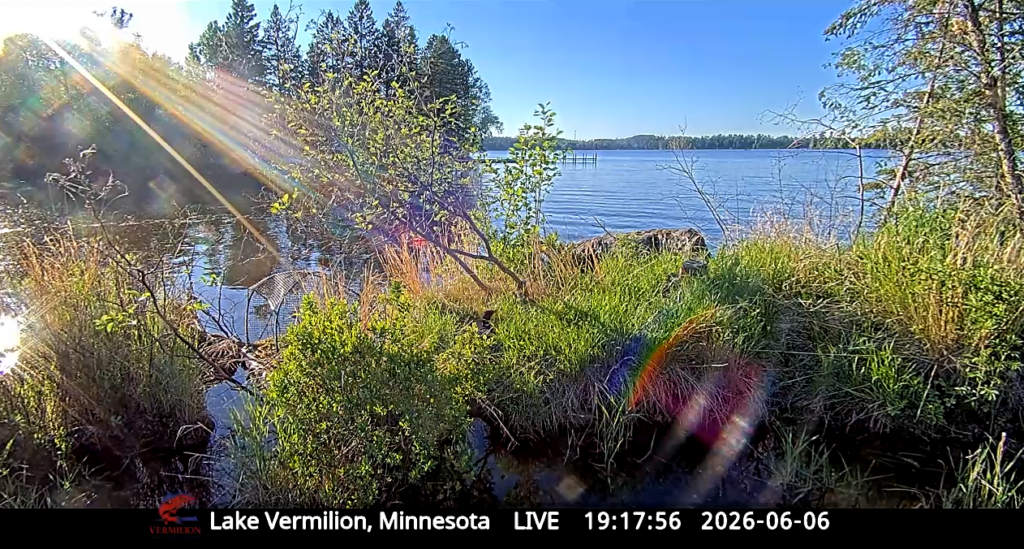
Loon enjoys the sunset the evening of June 6
Lake Vermilion, Minn. (VLA) – A bald eagle has been scaring the daylights out of “our” loons. And a Great Blue Heron has been paying regular visits.
Every day is an adventure for the mating loon pair we’ve been monitoring since May 15, when Mom Loon laid her first egg.
A person would have to have mastered the Loon Language and vocabulary to truly understand some of the interactions between the two of them. What’s very clear from our “highlight reel” from their first three weeks on the nest, however, is that they certainly have a caring relationship!
A big thank you to Bill Michaelson, Nancy Swanson, Tom Tamte and Rick Teeter for carefully installing our camera post this year. And to Bill and Tom for re-stringing a new Ethernet cable!
We’re grateful to Access Broadband of Virginia, Minnesota for the upload power to get our livestream to YouTube. Images from the livestream plus photos from Bill and Eric Hanson are the core of the video story below.
The Free Music Archive has provided the musical touches, and we thank the creators of these three tracks for allowing us to license and incorporate them:
*Joyful Story by Puma Tunes, used with CC BY-NC-ND 4.0 International License
*Shoreline Echo by Segue Music, used with CC BY-NC 4.0 International License
*Last Voyage by Maarten Schellekens, used with CC BY 4.0 International License
We are all hopeful as we approach “Hatch Day” in mid-June. Will it be June 11? June 12? Or…?
______________________________________________________________________________________________________________________________
______________________________________________________________________________________________________________________________
Marine Team deploys VLA’s Live LoonCam near nest site – May 17, 2026
By Noel Sederstrom, VLA Volunteer
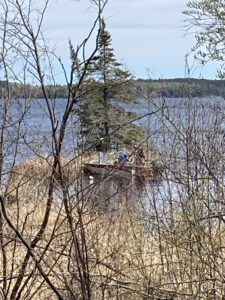
From the mainland, the loon nest site is visible through the brush
Lake Vermilion, Minn. (VLA) – With high hopes and a boatload of calm and patience, a marine team from the Vermilion Lake Association took advantage of the beautiful weather on May 17. It was time to deploy our “Live LoonCam” and its parabolic mic near the nest site Mom and Dad Loon had chosen two days earlier.
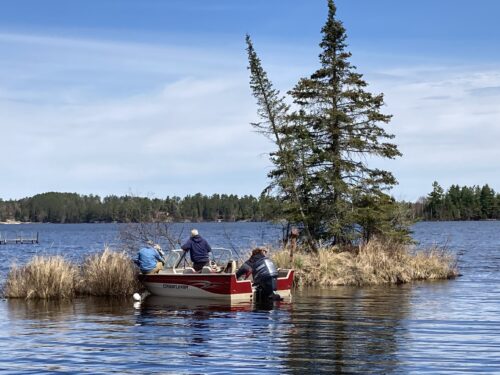
Our “Live LoonCam” is a sophisticated Axis P1465-LE camera mounted on a temporary post in the water; a custom parabolic mic on the post picks up the audio
Our goal is to let the world watch “our” mating pair of loons as they work to bring new loon chicks to Lake Vermilion. This is the sixth year of our project. We’re now using an Axis P1465-LE camera with remote zoom and focus, and night vision. We want to be close enough to see the activity in the nest, but far enough away to be able to watch the loons swimming nearby.
One of our observers spotted Mom Loon park herself up on the nest the morning of May 15 after laying an egg. It’s the same nest site these loons used last summer, when they were able to bring two new chicks into the world.
Mom Loon is quite familiar with the humans, and just ignores us, evidently understanding that we’re not a threat. We’ve watched many times over the years as the loons fend off bald eagles, mink and other intruders, screaming at them and even stabbing at them with their sharp beaks. For the loon to just look the other way as we did our work is quite a statement in itself. Our team was there for about an hour trying to get the placement of the cam just right, and then stringing an Ethernet cable to the cam post which sits in shallow water in a small bay.
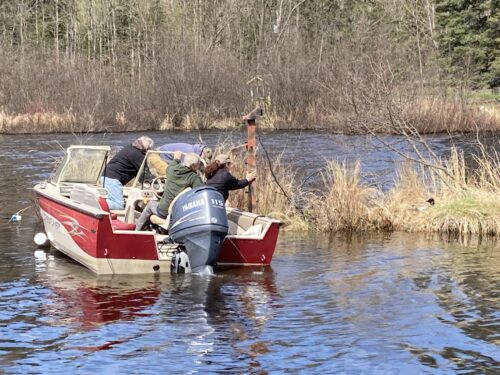
As Mom Loon watches, Tom, Rick, Bill and Nancy try to position the cable and post “just so”–close enough to see the nest activity, but far enough away to see the loons swimming nearby
The leader of our marine team, Bill Michaelson, created a way to attach weights to the post to hold it steady as it settles into its spot on the lake bottom.
This year two men carefully put the post in its place. Bill was the supervisor and Tom Tamte and Rick Teeter provided some of the muscle. Nancy Swanson was in the boat too, helping keep the boat steady with an oar, and helping guide the placement of the cable.
We use a waterproof Ethernet cable to get AC power to the cam, and to deliver its image signal back to our router. Because a beaver or muskrat chewed on the Ethernet cable ending last year’s Live LoonCam experience, we’re now using tough shielding around the last section of cable near the post.
After powering everything up, we realized that a section of our Ethernet cable apparently had lost its signal integrity—so Bill was forced to order a new cable and it’s “on the way.” We’re hoping to get it installed and get things going the week after Memorial Day.
______________________________________________________________________________________________________________________________
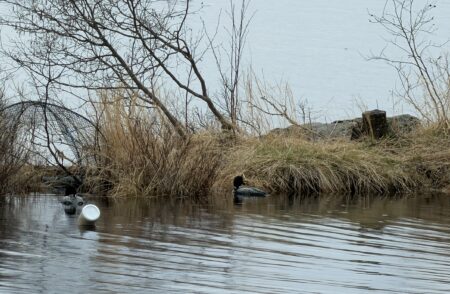
“Our” mating loon pair is spotted May 12 checking out the nest site they used last summer
Loons pick a nest site; Mom Loon promptly lays an egg – May 15, 2026
By Noel Sederstrom, VLA Volunteer
Lake Vermilion, Minn. (VLA) – After that swim-by visit the first week of May, “our” mating loon pair vanished out on the lake for about a week.
One of our LoonCam team members noticed them eyeing the nest they had used a year ago, near a small island off the Lake Vermilion mainland.
Then suddenly and without any further nest-building at all, Mom Loon was spotted back on that nest she had used successfully last spring and summer. She had laid an egg and was “on duty” keeping it warm and safe.
Best we can tell, incubation began May 15.
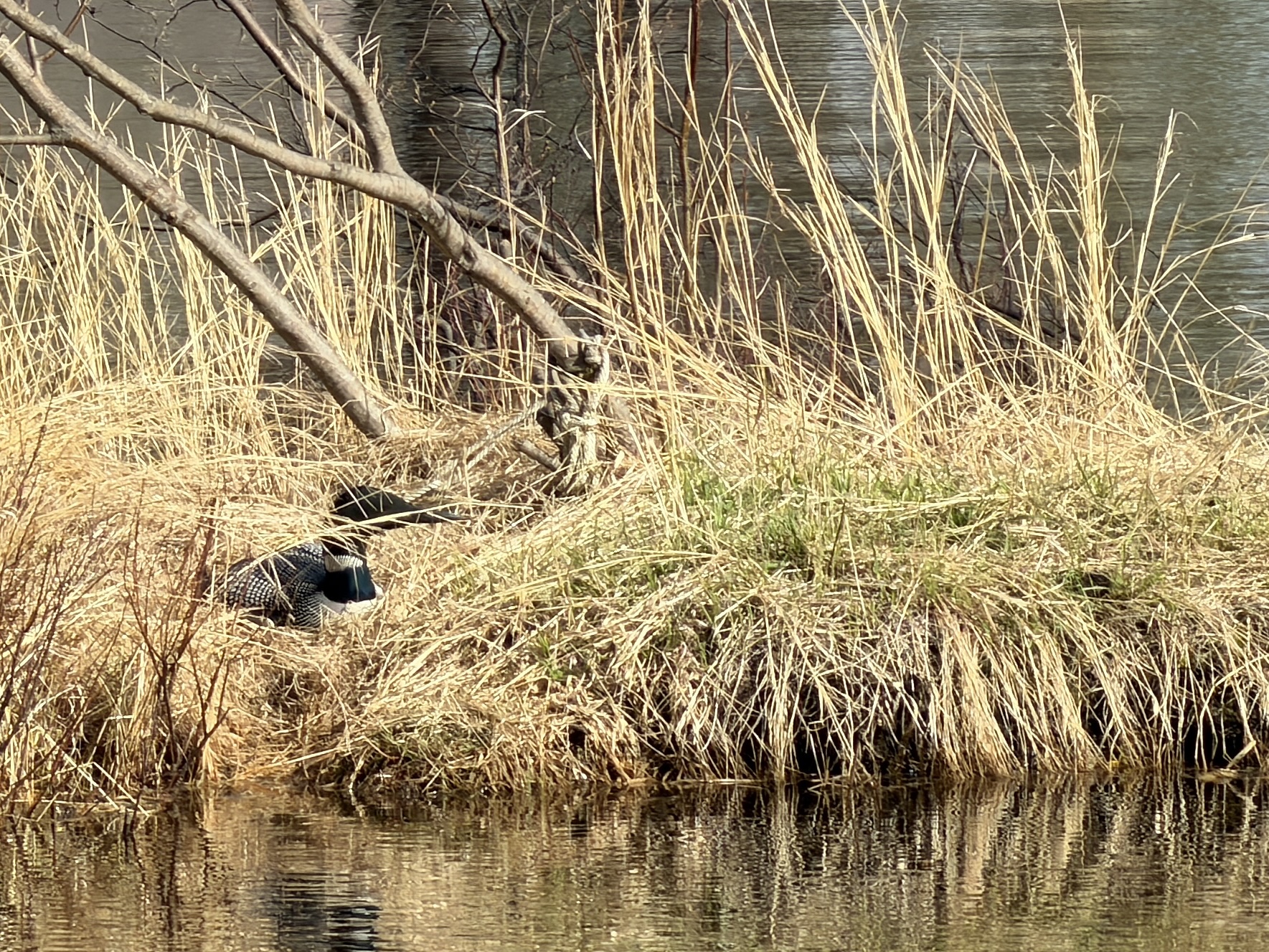
Mom Loon sits on her nest on May 15 after laying an egg
______________________________________________________________________________________________________________________________
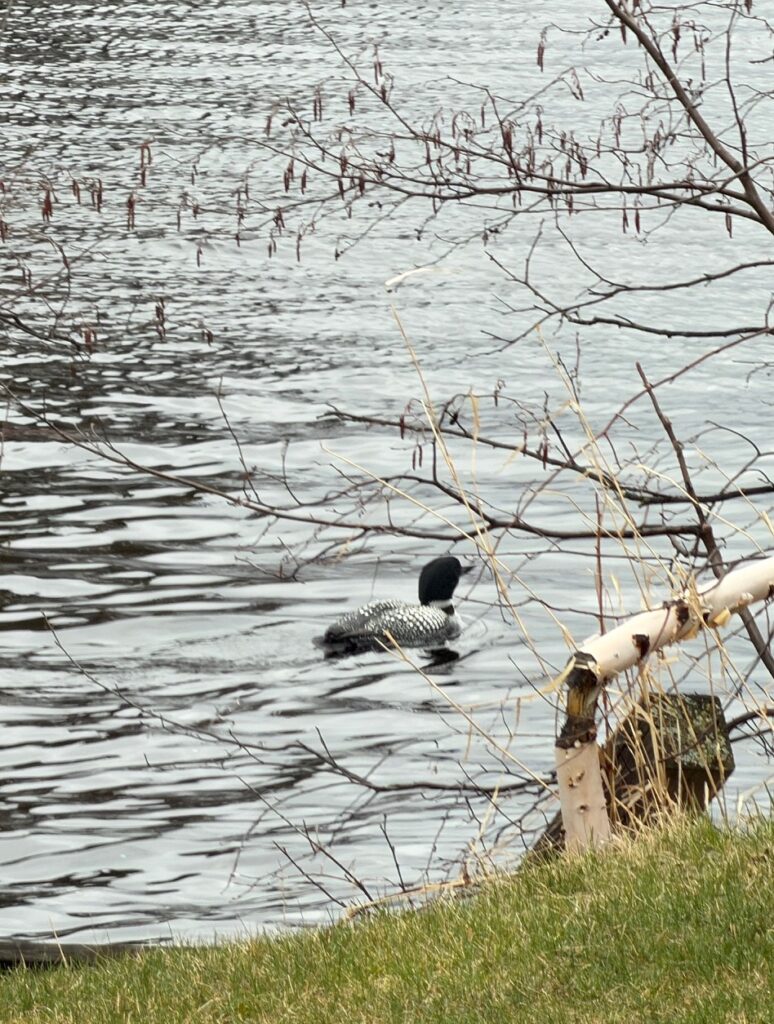
Ice out on Lake Vermilion declared by DNR on April 28, loons arrive the next day – May 4, 2026
By Noel Sederstrom, VLA Volunteer
Lake Vermilion, Minn. (VLA) – The loons flew north like a shot, landing back at their summer home as if they had gotten the “alert” directly from the Minnesota Department of Natural Resources.
A member of our Live LoonCam team reported spotting the loons arriving along the Lake Vermilion shoreline on April 29, the day after the Minnesota DNR declared the official “ice out” date.
“They are not exhibiting nesting behavior but they are swimming close by,” noted our observer.
Wildlife experts say Minnesota’s common loons often return to the same nesting sites year after year, after spending the winter months at warmer spots along the Gulf Coast and Eastern Atlantic seaboard.
______________________________________________________________________________________________________________________________
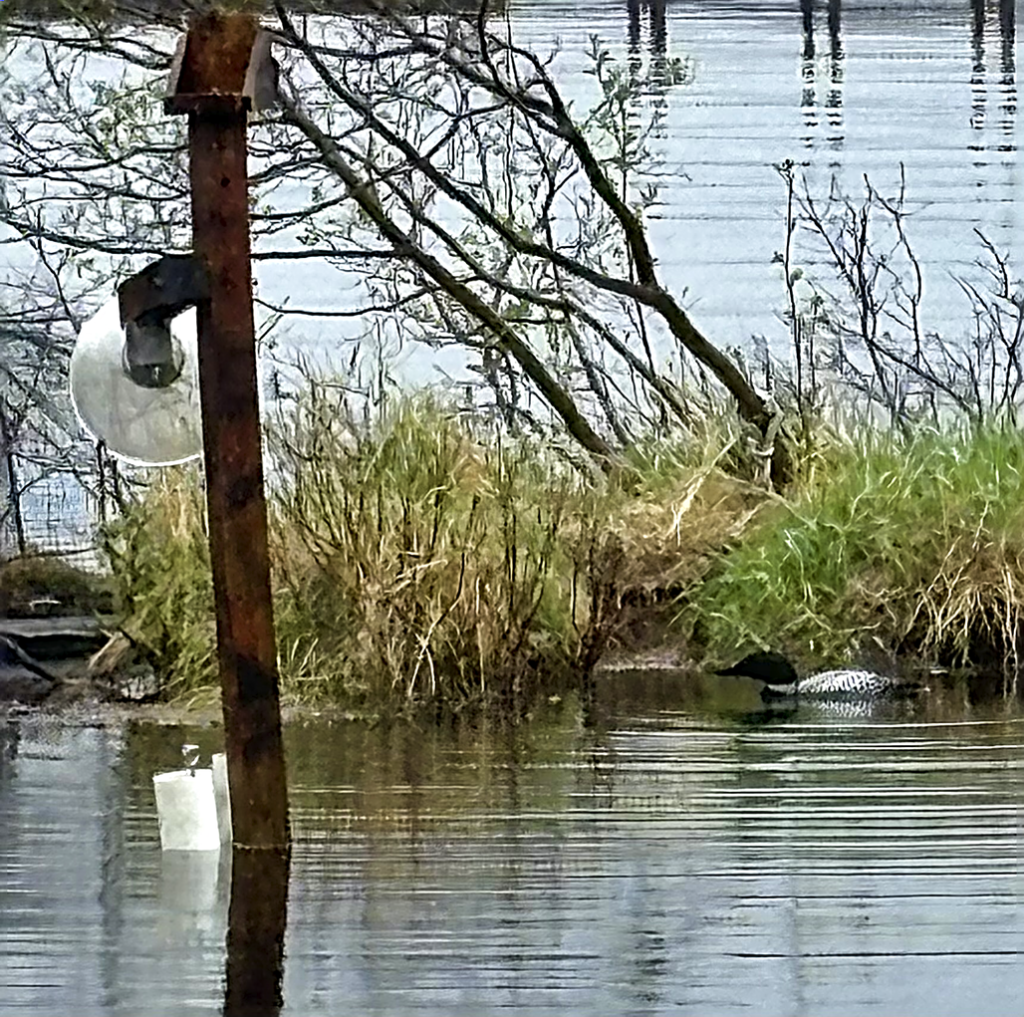
VLA’s Live LoonCam in May, 2025
It’s Time for Spring Cleaning… to protect our Lake Vermilion loons – April 26, 2026
By Noel Sederstrom, VLA Volunteer
Lake Vermilion, Minn. (VLA) – The harsh winter wind is a distant memory, and when the lake ice melts away our loons will rush back to their favorite places on Lake Vermilion.
Just like their human friends! We can’t wait for the open waters either.
Those of us on the VLA’s Live LoonCam team are getting ready to deploy our sophisticated Axis P1465-LE camera, our sensitive parabolic mic, and all the ethernet cables and switching gear. This will be our sixth year livestreaming a loon family’s almost every move from their nest on Lake Vermilion. Wish us luck.
Calling All Procrastinators
While we’re waiting for the Fishing Opener, there’s something important some of us need to do right now—a tackle box spring cleaning. There’s been proof for 40 years that a lot of loons are dying because of what some of us do when we go fishing. Nearly a third of the loons that don’t survive the summer months were poisoned by ingesting tangled fishing tackle, sinkers and jigs made of lead. Yes, you’ve heard this song many times before. But in spite of all the public awareness campaigns to “Get the Lead Out” waged the past three decades, loons are still being poisoned.
When Mardy Jackson sent the results of our Loon Survey to the DNR in 2001, members of the Sportsmen’s Club of Lake Vermilion got the first direct appeal. We were asked to protect our loons by stopping the use of lead sinkers and split shot on our fishing lines.
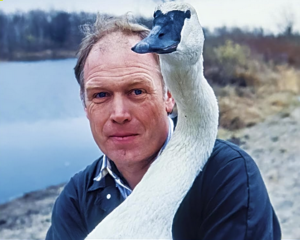
Carrol L. Henderson, Minn. DNR Non-Game Wildlife Supervisor (Retired)
“Please help us eliminate this hazard to our precious wildlife,” urged Carrol Henderson, then the Non-Game Wildlife Supervisor of the Minnesota DNR. Let that sink in for a moment—that was 25 years ago.
Since then, in this very newsletter, the same plea—in 2004, 2005, 2006, 2007, 2008, 2009. Then new pitches, in 2019, 2020, 2021, 2022. From Mardy Jackson, John Myers, Bob Pearson, John Yocum, Lori Ptak. This may well be “preaching to the choir” but I’m going to reach out to all those who just don’t get it yet.
Calling all procrastinators: this year’s top Spring Cleaning task is to sort through all the old tackle boxes and get rid of all the sinkers and jigs manufactured with lead. We are all good at putting things off. Without a resolute personal decision to get this done, it’s not going to happen. Even with good intentions, it’s quite confusing!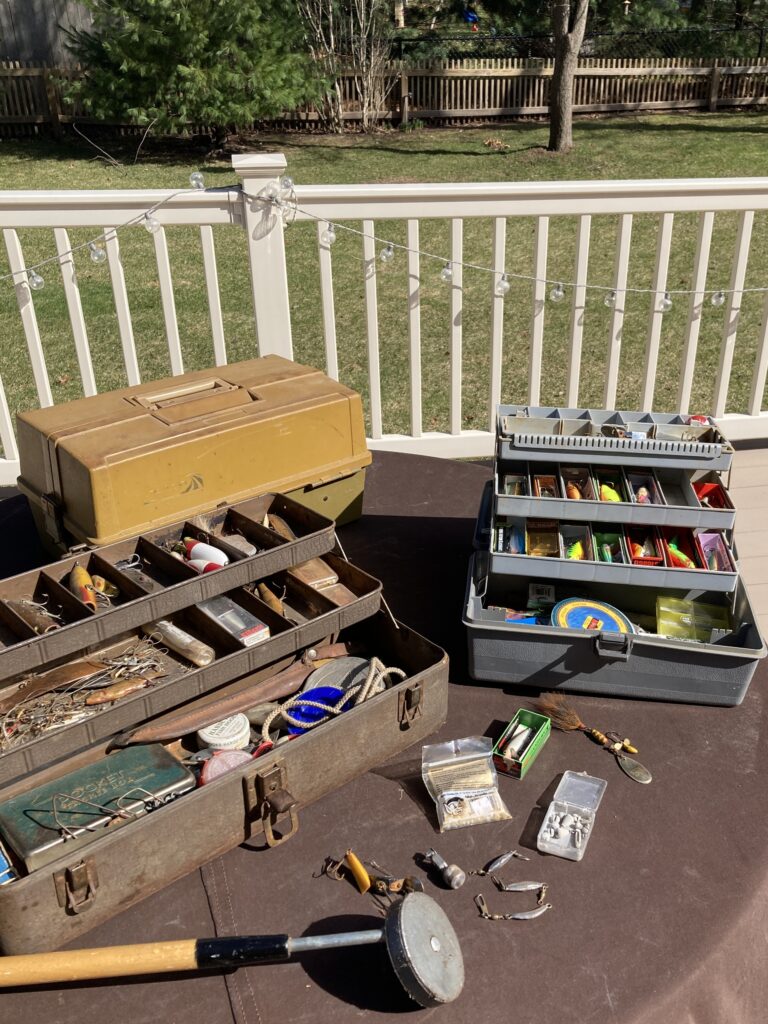
How exactly is a person supposed to go about this–? Let’s dive in; I will take you past the PR slogan and show you how to start. We begin with a look in the mirror.
Those Old Tackle Boxes
I somehow have collected four old tackle boxes on a shelf in the garage. When my kids would gift me a new Rapala, it always went in the newest one that I take to the cabin. Then 12 years ago, I inherited my dad’s old tackle box when he passed away, along with one that appears to be my grandfather’s. Really old. There’s also an old rusty metal tackle box full of random stuff I picked up for a song 25 years ago at a garage sale. I know some of the old sinkers inside are made from lead, because it says so right on the outside of one package. But 99% of this stuff is unmarked. It’s high time to go through this.
 The old gray sinkers and old painted heavy jigs are undoubtedly made of lead, cheap and malleable, still a manufacturer’s go-to today.
The Rapala lures declare they are “Made of Balsa” so that’s a relief. The metal spoons, I’m guessing, are steel because they jump on to my large magnet. The plastic lures and wood bass plugs should be OK…no? How can you tell? Look for dull gray metal.
That’s the first clue—lead is not magnetic, so it’s easy to verify my suspicions on sinkers and jigs with my big magnet, and start a box for the County Hazardous Waste Collection Site. There may be some larger trolling lures with zinc, brass or lead in them, but the experts say the real danger to our loons is with those smaller weights that resemble small pebbles.
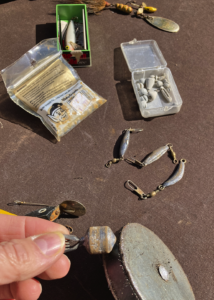
Using a powerful magnet to test for lead
If all of us could just focus on replacing these with non-toxic sinkers and jigs made from tungsten, tin, bismuth or steel, we will have done our part.
I also found lead sinkers built in to long metal stringers; those will have to go too. For anyone who hasn’t heard why… I will go through it with updates on all fronts.
A Massive Problem that Hasn’t Gone Away
The Michigan DNR estimates that 470-million lead sinkers are produced each year for fishermen in the U.S. That’s an estimated 2,700 tons of lead. It takes just one lead sinker or jig to kill a loon after it mistakes it for a pebble on the lake bottom. Loons use pebbles in their gizzards to help grind up their food. By instinct, they will seek out small pebbles (or swallow a sinker or jig on or near the lake bottom).
In February 2026, at the Tufts Wildlife Clinic in Massachusetts, veterinarian Dr. Mark Pokras completed the 5000th loon necropsy he’s performed since 1987. Over nearly four decades, Pokras found 28% of the dead loons had been poisoned after consuming lead sinkers or jigs. Researchers are finding the rate of poisoning is similar across multiple northern states including Minnesota.
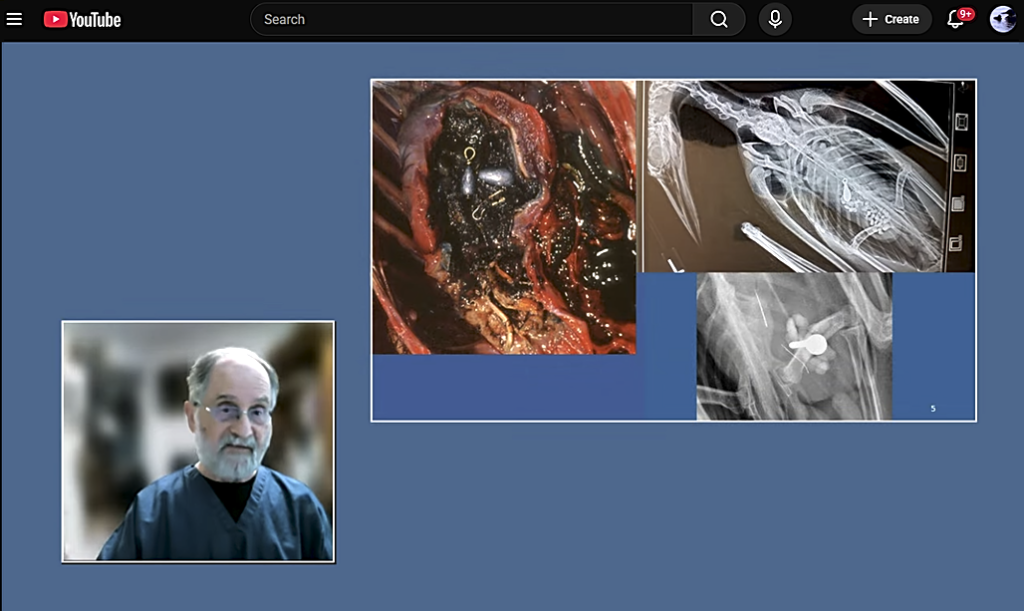
Image from YouTube courtesy of fishleadfree.ca and
Tufts University/Cummings School of Veterinary Medicine
Dr. Pokras’ conclusion: if we can convince people to stop using lead sinkers and jigs, we can significantly improve the survival chances of our loon population.
Fishermen want to get their bait down where the fish are swimming, and for decades, lead sinkers and weights have been their perfect solution and have been the industry standard. Experts estimate we are spending $87.5-million each year in the U.S. on lead sinkers. Even though there has been an urgent push encouraging sportsmen to switch from lead to non-toxic weights like tungsten or tin or bismuth for decades, it has been slow going. That’s because lead is cheap.
Lindy Tackle moved to the front of the crusade in May 2024 by pledging to go lead-free with all of its tackle products by 2027. Northland Tackle of Bemidji is also in a transition away from lead, and now features a lot of products made from tungsten, which is non-toxic. For a manufacturer, tungsten is four times more expensive than lead, so prices at retail are going to be higher. The Minnesota Pollution Control Agency (MPCA) now has a website list of 157 manufacturers and retailers with links to help you find new lead-free tackle. You can buy replacements on-line.
New Sinkers and Jigs
Let’s say you really prefer to do this in-person, so you head to the store intending to go non-toxic. Can a person actually find a sinker or jig that doesn’t have lead in it? I phoned ahead to a couple of retail clerks near Lake Vermilion to ask about their inventory. (This is what you’d call an unscientific survey.)
At the Y Store south of Lake Vermilion, the clerk on duty said “I honestly have no idea” if the sinkers on the shelf there were lead or tin or tungsten. After going over to look at what was for sale, he said “there’s no labelling at all” other than the description in English, followed by a version in Spanish.
At Odegaard’s (Fuel & Food) in Tower, a clerk said he knows the store has “tried to move in that direction” to get rid of fishing tackle products with lead. “But I’m sure some of the older stuff back there might have lead in it.” This is why.
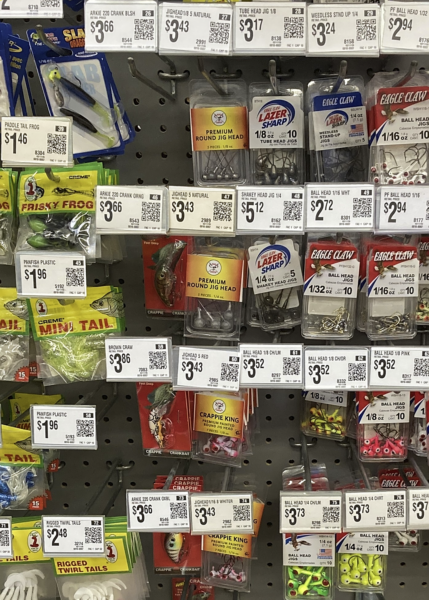
Fishing tackle containing lead is pervasive in our stores in 2026
If you’re one of those people who head to their local big box store hoping for the best prices, this is what you’ll find. Dozens of bags of inexpensive jigs and lures of all kinds, and virtually every one of them had a warning that it either contained lead or a substance that might cause cancer.
Some of the jigs were simply balls of lead with hooks attached.
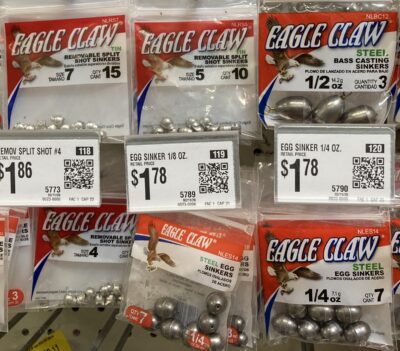
Non-lead options are often clearly labelled
But in a far corner, there was an area featuring sinkers made of tin and steel, made by Eagle Claw. This is real progress!
Even many of the more elaborate lures came with cancer warnings. My big takeaway—lead tackle is pervasive in our stores. A retailer like Cabela’s or Bass Pro Shops might have a better selection of tungsten, tin or steel tackle on display.
Searching online is less frustrating. VMC Rapala offers tungsten jigs and the typical range is $7.49-$11.99 each. Cabela’s offers a 72-piece case of split-shot sinkers with four different sizes for $8.99, and they are made of non-toxic tin.
If you’ll be staying at one of Lake Vermilion’s resorts this year, ask them to help you find non-toxic lead-free sinkers and jigs. In past seasons, some had their own tackle and bait shops, including Muskego Point Resort, Fortune Bay Marina, Gruben’s Marina & Resort, and Pehrson Lodge Resort.
“We have a few Tungsten jigs and sinkers in our tackle shop,” said Eric Hanson, the owner/operator of Pehrson Lodge Resort. “They do not sell well due to the high price. We get free samples from MPCA periodically which we give to people to help make them aware of non-lead options.”
Hanson said he takes part in the MPCA’s program to help tackle shops reduce the wholesale cost of nontoxic weights. His own observations: tungsten is still expensive, tin is a less appealing option because “it is much lighter than lead, but it does work.” He said bismuth is better, but expensive.
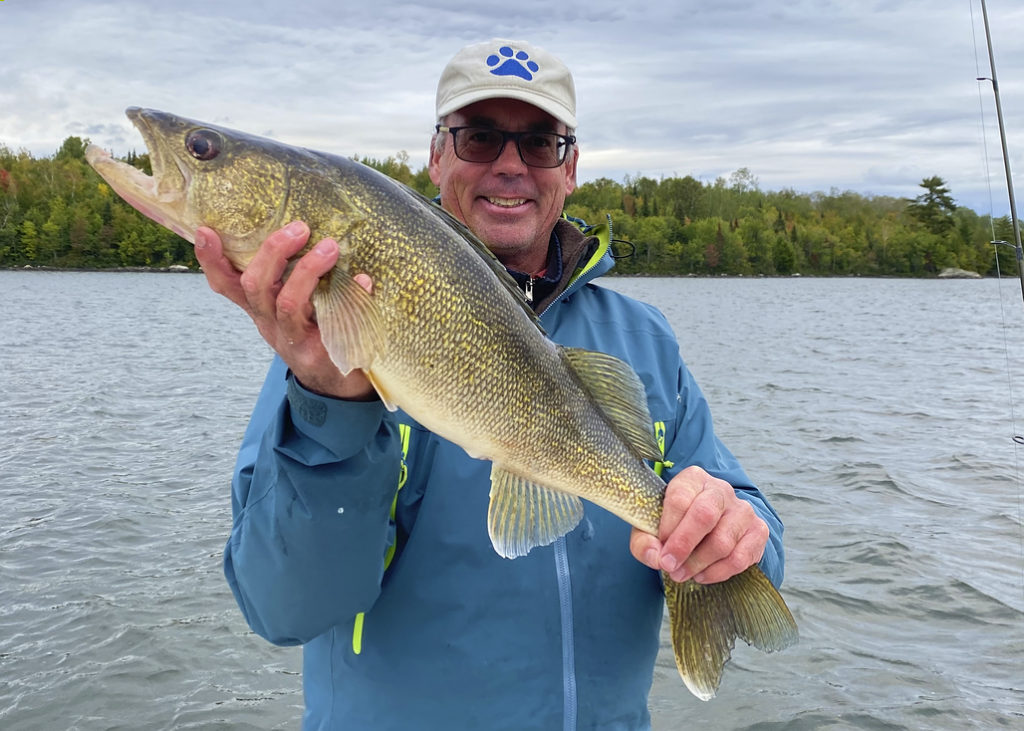
Eric Hanson, Pehrson Lodge Resort on Lake Vermilion
“I use tungsten jigs myself because they are nontoxic and I think they work a little better than lead,” Hanson noted. “The smaller profile to weight ratio lets them go a little deeper with less size. They also show up well on a depth finder, so I can see where my bait is. This holds true for tungsten bullet weights for Lindy rigging as well. It’s not easy to get people to spend more money, when lead is a tried-and-true cheaper option.”
What do we have to do to get lead sinkers and jigs out of our stores? Because lead is so much cheaper, evidently it will require novel ideas or tough laws. In 1987, Great Britain banned lead sinkers under one ounce in fishing tackle, and since then the endangered mute swan population has doubled.
Circling back to that Minnesota MPCA program Hanson mentioned. It literally has been paying retailers to help them make the switch to offer tungsten tackle, with 45% rebates, up to $3,000 per location. In all, 13 businesses benefited from the rebates to switch to the tune of $12,500 from 2020-2024, growing to an updated total of 22 businesses receiving $55,600 by this spring. The updated totals come from a Q/A Zoom chat with MPCA’s Steven Yang–here’s a link if you want to hear directly from him about the MPCA’s programs as of mid-April.
The first round of rebates was funded by the Deepwater Horizon oil spill settlement of 2016. In the Cook-Virginia-Tower-Ely region, only one store had taken advantage of the rebates offered in that first 2020-2024 program cycle—Arrowhead Outdoors of Ely.
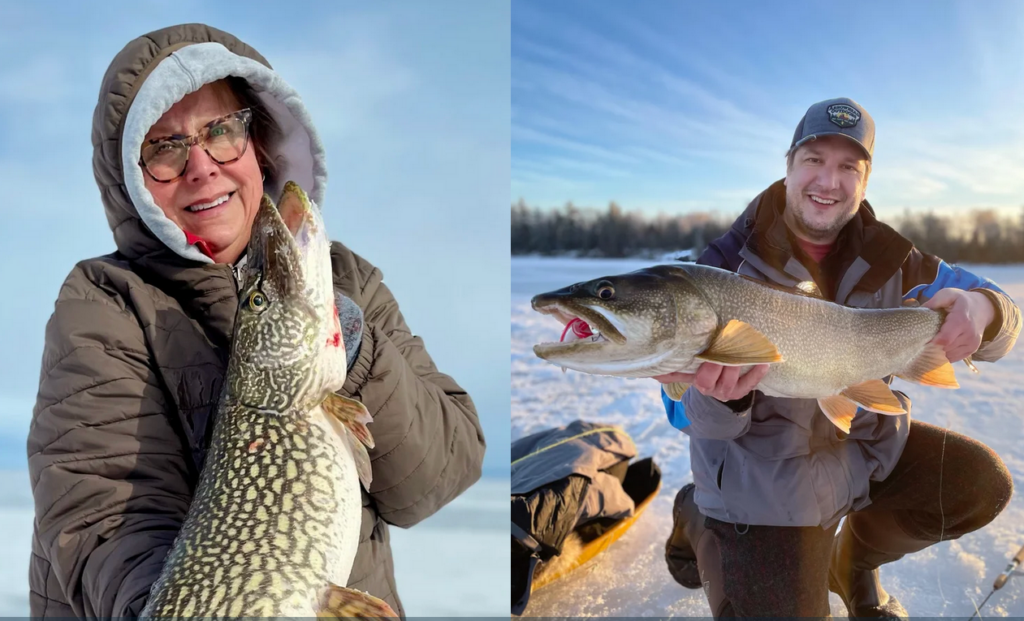
Kris Winkelman & Steve Renneberg, Arrowhead Outdoors, Ely
Yang noted the State Legislature provided continued funding a couple of years ago for the latest round of “Get the Lead Out” efforts.
“We try to guide people to lead-free tackle,” said Kris Winkelman of Arrowhead Outdoors. “It is more expensive. We try to explain why we’re doing it, fish health, loon health, other birds health. And we do get positive reaction. But it’s been difficult. It’s mainly the price.”
Kris, a cousin of renowned Minnesota Fishing Hall of Famer Babe Winkelman, said as an outfitter for people heading into the Boundary Waters Canoe Area Wilderness, it helps there’s an awareness lead tackle is strongly discouraged in adjacent Quetico Provincial Park in Ontario.
“The reason we used the rebates to stock lead-free tackle, is that our customers were asking for it,” said Steve Renneberg. “They had seen it on the news, that loons had been dying.”
Renneberg noted however that most stores won’t carry a product if they can’t move it in large volumes. And that’s why some stores don’t even carry lead-free tackle at all. There’s still not enough demand for it in 2026.
Warnings, Bans, Buy-back Programs, Tackle Exchanges
As Dr. Mark Pokras observes, we have known for 3,000 years that lead is toxic to living things. But there are different ideas on how best to confront this danger. California led the way with warnings on packaging about cancer-causing substances, but there’s resistance there to an outright ban on lead tackle.
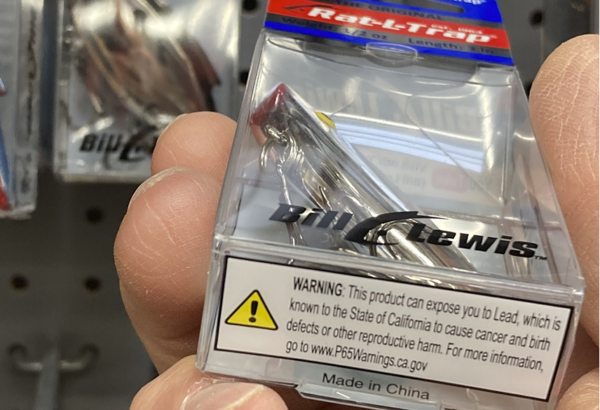
California has helped by requiring warning labels for lead content
New Hampshire, Maine, Massachusetts, Vermont and New York have all taken steps to ban small lead sinkers and jigs but they have different approaches. Vermont and New York have outlawed small lead pieces weighing 0.5 ounces or less. The other three have all targeted sinkers and jigs one ounce or less. Maine has been allowing the use of painted lead jigs so far but a total ban on them will begin September 1.
Maine Audubon is partnering with other groups to hold “tackle exchanges” to help get the lead weights out of tackle boxes. New Hampshire has been staging lead tackle buy-back programs, giving out $20 vouchers using donations from the Loon Preservation Committee.
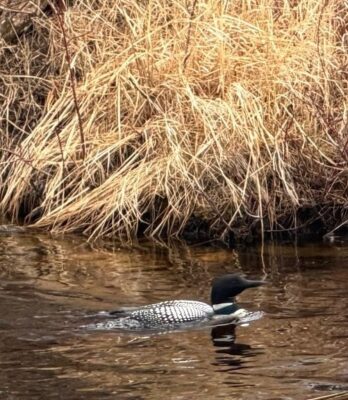 Minnesota has tried that approach too. Using funds from that Gulf of Mexico oil spill legal settlement, the MPCA is again this year offering to help organizations willing to host tackle exchanges. Old lead tackle is collected for disposal, and sample kits of non-toxic sinkers and jigs are given out.
Even this idea is not new—back in July of 2006, Northwoods Bait & Tackle in Cook held a lead tackle exchange. But alternatives to lead tackle have not won out—even there. “People don’t want to pay that crazy price (for tungsten)” said one fisherman in Cook.
Climbing a Steep Hill
Loon protectors face a steep uphill climb on the threat posed by lead in fishing tackle.
It’s a marathon. We can’t see the finish line. But we can put one foot in front of another.
Let’s do a little spring cleaning for the loons’ sake.
______________________________________________________________________________________________________________________________
______________________________________________________________________________________________________________________________
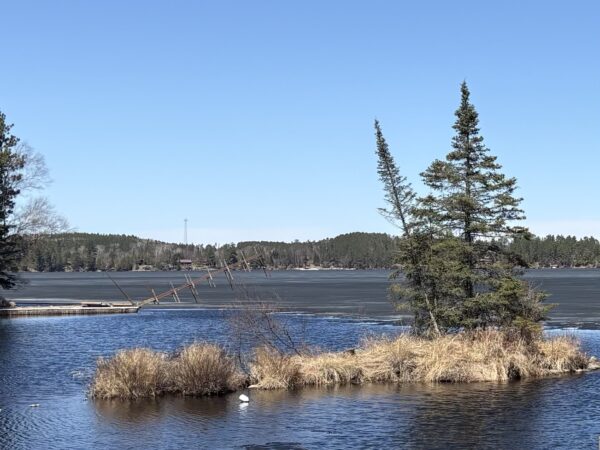
Lake Vermilion’s ice surface melts away the last week of April, 2026
Ice is melting away on Lake Vermilion – April 24, 2026
By Noel Sederstrom, VLA Volunteer
Lake Vermilion, Minn. (VLA) – It’ll only be a matter of days now until the lake’s ice will be completely gone. Once that happens, our loons usually fly back from their southern U.S. “Snowbird” homes within days.
This is what our loon family’s usual home looked like on April 24. Thanks to Bill Michaelson for running over to get the photo!
In early May, our Vermilion Lake Association’s Live LoonCam team anticipates powering up our surveillance camera on a post in the water, along with our parabolic dish mic so we can also listen to the lake.
The images will get out to the world thanks to our internet partner, Access Broadband of Virginia. Watch for it!
To see all of our archived LoonCam coverage from Summer, 2025 or earlier years just click on the links below—there you’ll find articles, photos and video clips about our loon pair’s determined effort to hatch new chicks on Lake Vermilion.
____________________________________________________________________________________________
2025 Lake Vermilion Loon Camera Live Stream – ARCHIVE
2024 Lake Vermilion Loon Camera Live Stream – ARCHIVE
2023 Lake Vermilion Loon Camera Live Stream – ARCHIVE
2022 Lake Vermilion Loon Camera Live Stream – ARCHIVE
2021 Lake Vermilion Loon Camera Live Stream – ARCHIVE
____________________________________________________________________________________________
In March, 2021, the Vermilion Lake Association launched a team to design and build a live camera system that could stream a live view of a loon’s nest during the summer months to our website and to YouTube, also creating content for our Facebook friends. Thanks to our members whose annual dues paid for the equipment, and to Access Broadband of Virginia, MN, for the WiFi service that makes this possible. It’s our intent to keep the location of the live LoonCam unidentified to protect the privacy of the loon family and their human neighbors.
For more information on our loon population and loon stewardship, please visit https://www.vermilionlakeassociation.org/other-programs/loon-information/.